

RF and Wireless
Enicstra stocks industrial RF and wireless components used to extend control and monitoring to locations where running cable is impractical: wireless I/O bridges that pair an emitter and receiver with discrete or analog I/O across hundreds of meters, sub-GHz radios for long-range telemetry, WirelessHART transmitters and gateways for process plants, industrial Wi-Fi access points and clients for AGV and mobile equipment, and ISM-band serial radios for legacy serial-protocol extension.
Brands carried include Banner SureCross and Q45 wireless, Phoenix Contact Radioline, Schneider/Trio licensed-band, Hirschmann BAT wireless, Cisco IW industrial wireless, Moxa AWK industrial Wi-Fi, ProSoft Wireless, Emerson WirelessHART gateways and adapters, and Pepperl+Fuchs WirelessHART. Obsolete wireless modules are sourced through our supplier network. Each unit is bench-tested for link function and ships with a 12-month functional warranty.
For an obsolete RF or wireless module, send the OEM part number for a quote within 1–2 business days.
Subcategories
RF Accessories
59 products

Embedded RF modules — sub-GHz, 2.4 GHz, Bluetooth, LoRa, and proprietary transceivers for OEM integration.

RFID Readers and Antennas
147 products
Industrial RFID readers, antennas, and tags for asset tracking and tool ID — current and obsolete in stock.
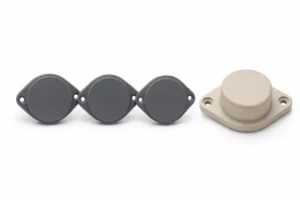
RFID Transponders and Tags
61 products
Industrial RFID tags and transponders — LF, HF, UHF read/write tags for tool ID and part traceability.
RF and Wireless

Can't Find The Part You Need?
Send us the part number, manufacturer, quantity, and condition — we'll locate it.
Do you stock obsolete wireless I/O bridges?
Yes. Discontinued Banner SureCross first generations, retired Phoenix Contact Radioline early codes, end-of-life ProSoft Wireless, and earlier Moxa AWK are sourced through our supplier network.
900 MHz vs. 2.4 GHz — which should I use?
900 MHz for long-range, low-bandwidth telemetry through obstructions — ranges of kilometers with good antennas. 2.4 GHz for higher bandwidth at shorter range, but more interference. For point-to-point I/O at 1+ km, 900 MHz is usually better.
Do I need a license to use this?
ISM bands (900 MHz, 2.4 GHz, 5 GHz in US) are unlicensed for general use within regulatory power limits. Licensed VHF/UHF bands require an FCC or country-equivalent license but offer interference-free operation and longer range.
Will my old wireless I/O configuration work on a replacement?
If the model and firmware match, yes — configuration files load from the OEM software. Pairing emitter-receiver pairs often requires a manual pair-binding step after replacement.
Can I extend Ethernet wirelessly between buildings?
Yes — industrial Wi-Fi access points in bridge mode or licensed-band point-to-point links handle building-to-building Ethernet. Range depends on line-of-sight, antennas, and licensed/unlicensed band choice. Outdoor-rated equipment is required.
What is the warranty?
12-month functional warranty. Damage from antenna surge (lightning), over-voltage, or operation outside rated environment is not covered. Surge protection on antenna lines is strongly recommended.