

Retroreflective Target Reflectors
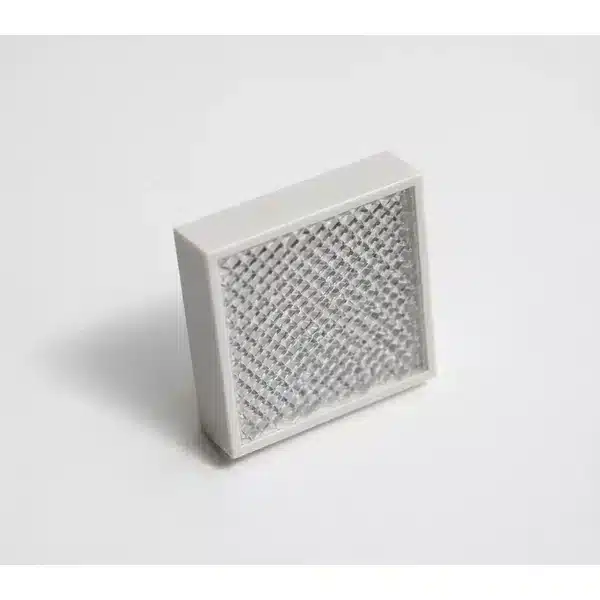
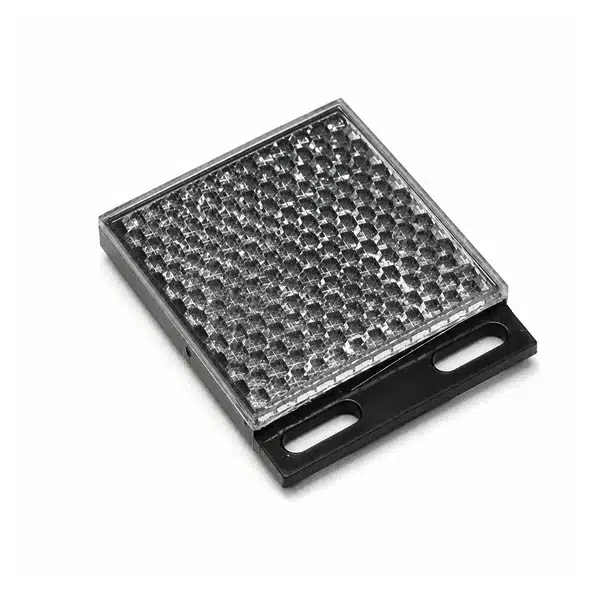
Retroreflective target reflectors are the specific passive targets used with retroreflective photoelectric sensors — the most common photoelectric sensing mode in factory automation. They use corner-cube or prismatic optics to return the sensor's beam along the same path it was sent, regardless of the angle of incidence within the reflector's acceptance cone.
Enicstra stocks standard retroreflective target reflectors in round (typical sizes 25 mm to 84 mm), square, and adhesive tape formats. Coverage spans Banner BRT series, SICK PL-series, Pepperl+Fuchs, Omron, and Keyence OEM-matched reflectors, alongside generic equivalents. We carry obsolete reflector part numbers — particularly the larger, longer-range designs — that match legacy installed sensors. Inventory is visually inspected before shipment.
When the original reflector is no longer available, a generic equivalent often works at reduced range — confirm the sensor's specified sensing distance in the data sheet with the alternate reflector. Send the OEM part number for guaranteed equivalence; most quotes reply within 1–2 business days.
Retroreflective Target Reflectors
Can't Find The Part You Need?
Send us the part number, manufacturer, quantity, and condition — we'll locate it.
Can you source legacy Banner BRT-84 or SICK PL80A reflectors?
Yes — long-range retroreflective targets including BRT-84, BRT-150, SICK PL-series, and similar OEM-matched reflectors are common requests. Many are interchangeable functionally even when no longer produced.
Will a generic reflector work with a Banner sensor?
Often, yes — but at reduced range. Banner's OEM reflectors are tuned for maximum sensing distance with their sensors. Substituting a generic typically gives 50–80% of the original range, which may still be enough depending on your installation.
What's a "polarized" reflector and when do I need one?
Polarized retroreflective sensors transmit polarized light and only accept light returned with rotated polarization — the property that lets them reject shiny objects (which return non-rotated light). They require special polarization-rotating reflectors. Standard prismatic reflectors won't return rotated polarization correctly.
How often should reflectors be cleaned?
Inspection schedule depends on the environment. Clean indoor environments: every 6–12 months. Welding cells, food processing, or dusty environments: monthly or weekly. Outdoor installations: at least quarterly, with UV-stabilized reflectors preferred.
Are reflectors new?
Yes. All products offered for sale by Enicstra are new. For obsolete or hard-to-find part numbers, we search our supplier network for new inventory.