

Inkjet Printers
Enicstra stocks industrial inkjet printers used for non-contact marking of lot codes, date codes, batch numbers, and barcodes directly onto products and packaging. Inventory covers Continuous Inkjet (CIJ) printers for high-speed marking of porous and non-porous surfaces, Thermal Inkjet (TIJ) printers for simpler installations with cartridge-based ink supply, and large-character valve-jet printers for case and corrugated marking.
Brands carried include Videojet 1000-series, 8000-series, and Wolke TIJ, Domino A-series, A-GP, and V-series, Markem-Imaje 9028/9028 Smart/9040/9410/9450, Hitachi UX-series, Linx 7900/8900/CJ400/TT500, KGK Jet, and Squid Ink TIJ. Obsolete inkjet printers — discontinued Videojet Excel, retired Domino A100, end-of-life Markem-Imaje 5800, and earlier Hitachi PXR-series — are sourced through our supplier network. Each unit is bench-tested for power-up and basic ink flow and ships with a 12-month functional warranty on hardware.
For an obsolete inkjet printer, send the OEM part number for a quote within 1–2 business days.
Inkjet Printers

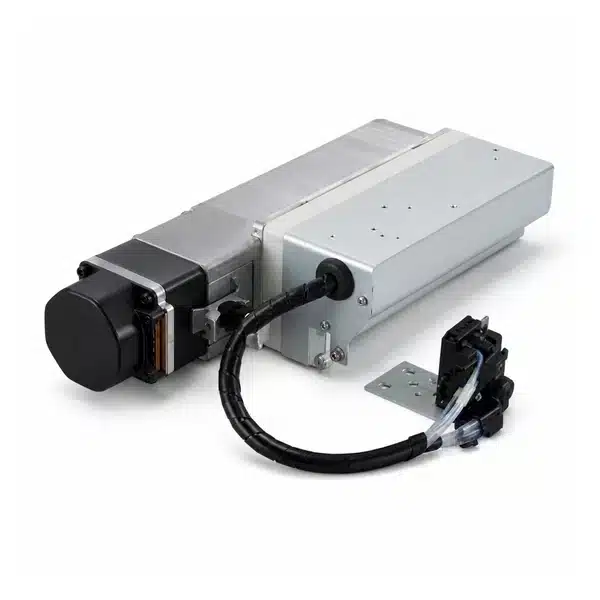
$2,760.36/ea
In Stock
Can't Find The Part You Need?
Send us the part number, manufacturer, quantity, and condition — we'll locate it.
Do you stock obsolete Videojet, Domino, and Markem-Imaje printers?
Yes. Discontinued Videojet Excel 170i/270i, retired Domino A100/A200, end-of-life Markem-Imaje 5800/9028 early codes, and earlier Hitachi PXR-series are sourced through our supplier network.
CIJ vs. TIJ — which is cheaper to run?
For high-volume continuous production, CIJ has lower cost per mark (bulk ink + makeup fluid). For low-to-moderate volume with simpler maintenance preferences, TIJ's cartridge model is more convenient even at higher per-print cost.
Will the printer mark my surface?
Surface compatibility depends on the ink chemistry. Porous (paper, cardboard, wood) is universal. Non-porous (glass, plastic, metal) requires MEK-based or specialty inks. We can provide ink-compatibility charts on request.
Can it integrate with my PLC?
Most modern inkjet printers offer Ethernet/IP, Profinet, Modbus TCP, or serial integration. Variable data (lot codes, serials) is pushed from the PLC. Specify the communication interface needed.
What's the maintenance schedule?
CIJ: daily nozzle cleaning, weekly fluid checks, periodic filter changes (every 2000–4000 hours). TIJ: cartridge changes as ink depletes (no other maintenance). Missing CIJ maintenance is the leading cause of unplanned downtime on inkjet lines.
What is the warranty?
12-month functional warranty on hardware. Damage from ink contamination, missed maintenance, or operating with non-OEM consumables is not covered.