

DIN Rail Power Supplies
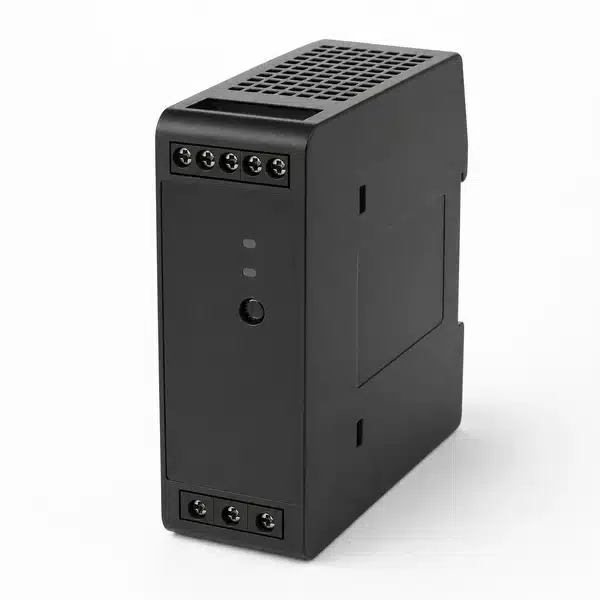
Enicstra stocks DIN-rail mount power supplies — switching PSUs designed to clip directly onto 35 mm DIN rail in industrial control cabinets. DIN-rail format is the dominant industrial PSU standard because it integrates cleanly with terminal blocks, breakers, and other rail-mounted devices, and is removable without disturbing the cabinet wiring layout.
Brands carried include Phoenix Contact QUINT and STEP, Puls Dimension and MiniLine, Siemens SITOP PSU100D/200D/300S, Allen-Bradley 1606-XL, TDK-Lambda DRB and DPP, Mean Well DR/HDR/NDR/DRP, Murr Elektronik Eco/Emparro, and Carlo Gavazzi SPD. Obsolete DIN-rail PSUs — discontinued QUINT first generations, retired Dimension legacy codes, end-of-life 1606-XLP — are sourced through our supplier network. Each unit is bench-tested under load and ships with a 12-month functional warranty.
For an obsolete DIN-rail power supply, send the OEM part number for a quote within 1–2 business days.
DIN Rail Power Supplies





Can't Find The Part You Need?
Send us the part number, manufacturer, quantity, and condition — we'll locate it.
Do you stock obsolete DIN-rail PSUs?
Yes. Discontinued Phoenix Contact QUINT first generations, retired Puls Dimension early codes, end-of-life 1606-XLP, and earlier Mean Well DR-series codes are sourced through our supplier network.
Single-phase vs. three-phase input — when is each appropriate?
Single-phase 120/240 VAC for outputs up to ~10–15 A at 24 VDC. Above that, three-phase input distributes load across all phases and avoids high single-phase current draw. Match to the existing cabinet supply.
What is "power boost" or "dynamic boost"?
Short-term overload capability above the continuous rating — typically 150% for 5 seconds, enough to handle motor starting or solenoid inrush without forcing the supply oversize. Useful in dynamic load applications.
Do I need a redundancy module?
For critical applications (safety PLCs, hot-standby controls), yes. Two parallel PSUs without a diode module do not provide redundancy — one back-feeds the other through its output. A redundancy diode module (also DIN-rail mounted) provides the isolation.
How tight should the PSU be mounted to adjacent components?
Most DIN-rail PSUs need 20–50 mm clearance above and below for convection cooling. Stacking without spacing reduces effective output current and shortens lifetime. Datasheets specify exact spacing.
What is the warranty?
12-month functional warranty. Damage from over-voltage on input, output short beyond protection, or insufficient cabinet ventilation is not covered.