
Introduction

In the highly complex, mathematically rigid environment of Industry 4.0 manufacturing, data bottlenecks represent the most severe threat to operational throughput. Traditional, centralized Programmable Logic Controller (PLC) architectures—where thousands of discrete copper field wires are physically pulled back to a single, monolithic control cabinet—induce catastrophic signal degradation, massive installation overhead, and severe electrical interference. To mathematically eradicate these physical and digital constraints, the strategic deployment of high-speed I/O terminals distributed directly at the machine level is an absolute engineering mandate. By migrating from centralized chassis racks to decentralized communication nodes, facility engineers can drastically minimize latency, isolate high-voltage noise from sensitive logic circuits, and unlock true deterministic control.
The transition toward distributed logic is not merely a wiring convenience; it is a fundamental evolution in industrial network physics. When a central CPU attempts to process thousands of inputs over vast distances using analog voltage drops, the inherent resistance of the copper wire slows the scan time, introducing unacceptable jitter into highly synchronized robotic cells. Modern modular I/O systems utilize advanced bus couplers to aggregate these localized analog and digital signals, converting them instantaneously into highly compressed, high-velocity digital packets that are transmitted over standard CAT6 or fiber-optic media.
This comprehensive B2B technical guide aggressively deconstructs the packet physics of deterministic Ethernet protocols. We will deeply analyze the stringent grounding and shielding specifications required for zero-fault integration, evaluate the topological limits of bus couplers, and detail exactly how leveraging an elite automation parts sourcing network guarantees unparalleled architectural scalability for your entire decentralized control infrastructure.
Core Bus Communication & Decentralized Logic

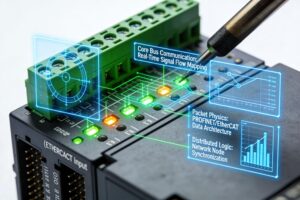
To objectively comprehend the structural superiority of distributed terminals, control engineers must deeply analyze the precise mechanics of industrial Ethernet packet physics. Standard office-grade Ethernet (IEEE 802.3) operates on a CSMA/CD (Carrier Sense Multiple Access with Collision Detection) principle, which mathematically permits data collisions and variable packet delivery times. This non-deterministic behavior is catastrophically unacceptable in high-speed motion control, where a 10-millisecond delay results in a servo motor crashing through a mechanical limit switch. To circumvent this, industrial bus couplers utilize specialized, deterministic protocols such as PROFINET, EtherNet/IP, and EtherCAT.
PROFINET achieves determinism by bypassing standard TCP/IP layers for critical data, utilizing Isochronous Real-Time (IRT) channels to reserve dedicated bandwidth bandwidth strictly for I/O updates, mathematically guaranteeing cycle times down to 250 microseconds. EtherNet/IP deploys the Common Industrial Protocol (CIP) utilizing precise CIP Sync IEEE 1588 precision time protocols to synchronize distributed clocks across all network nodes to within nanoseconds, ensuring absolute kinematic coordination across sprawling distributed control networks.
EtherCAT physics operate on a fundamentally different paradigm known as ‘processing on the fly.’ Instead of the master PLC sending individual data packets to each specific terminal node, it transmits a single, massive Ethernet frame traversing the entire ring topology. As this frame passes through the specialized Application Specific Integrated Circuit (ASIC) inside each high-speed I/O terminal, the local node reads its designated output data and instantly injects its input data into the moving frame with a delay of mere nanoseconds. This relentless, uninterrupted data stream mathematically maximizes bandwidth utilization, allowing engineers to control thousands of localized I/O points with virtually zero discernible network latency.
Scaling Automation Networks in Industrial Hubs
The strategic deployment of decentralized control logic is aggressively dictated by the massive physical scale of modern industrial architecture. Consider the rapidly expanding high-tech manufacturing corridors and advanced aerospace fabrication centers located in Guizhou, China. These sprawling complexes feature assembly lines that stretch for hundreds of meters. Consequently, attempting to route a 24V DC sensor signal from the end of a 300-meter conveyor back to a central control room introduces severe voltage drops due to copper resistance. Therefore, the signal arriving at the central PLC is frequently too degraded to register a definitive ‘TRUE’ logic state, resulting in catastrophic blind spots for the control system.
Furthermore, these massive physical distances act as giant antennas, absorbing massive amounts of Electromagnetic Interference (EMI) generated by surrounding high-amperage robotic welders and Variable Frequency Drives (VFDs). Consequently, centralized analog signals are routinely corrupted, inducing violent, unpredictable machine actuation. Therefore, facility engineers in these advanced Guizhou hubs strictly mandate the deployment of decentralized terminal block sourcing solutions. By mounting a localized bus coupler directly onto the machine frame, sensors only require a highly economical 2-meter cable run to reach the terminal.
Furthermore, the local bus coupler instantly converts this short-run analog voltage into an optically isolated, highly encrypted digital packet. Consequently, this digital data is transmitted flawlessly over shielded fiber-optic lines across the entire 300-meter factory floor with zero signal degradation. Therefore, by outsourcing the heavy data acquisition to decentralized edge nodes, the central CPU is mathematically liberated from processing low-level electrical noise. Consequently, this architectural migration secures continuous, high-margin manufacturing throughput, entirely isolating the facility’s production velocity from the catastrophic risks of long-distance analog signal corruption.
Comparison Matrix: Distributed Communication Topologies
To objectively evaluate the structural and financial viability of varying decentralized network topologies, procurement engineers must critically analyze comparative communication data. The following matrix mathematically contrasts core I/O networking architectures across critical integration metrics:
| Network Topology | Deterministic Latency & Speed | Bandwidth & Data Capacity | EMI / Electrical Interference Resistance | Architectural Scalability |
| Industrial Ethernet (PROFINET / EtherCAT) | Supreme. Microsecond to Nanosecond synchronization; absolute determinism. | Massive (100 Mbps to 1 Gbps). Easily handles complex diagnostic and analog data. | Excellent. Utilizes differential signaling and optical isolation within the couplers. | Unlimited. Seamlessly integrates thousands of nodes via switches and ring topologies. |
| Legacy Fieldbus (Profibus DP / DeviceNet) | Moderate. Operates on slower baud rates (e.g., 12 Mbps max for Profibus). | Low. Strictly limited payload sizes; struggles with high-density analog arrays. | High, provided the rigid termination resistors and specific shielding protocols are met. | Restricted. Hard limits on physical cable lengths and maximum nodes per network segment. |
| Wireless I/O (IO-Link Wireless / 5G) | Variable. Subject to atmospheric packet loss and re-transmission jitter. | High (via 5G), but highly dependent on the physical density of the factory. | Vulnerable. Heavy steel machinery and concrete structures severely attenuate RF signals. | Excellent for mobile assets (AGVs, rotating turrets) where physical cabling is impossible. |
| Direct Hardwiring (Centralized) | Instantaneous electrical propagation, but CPU scan times become the bottleneck. | None. Purely electrical voltage/current; zero digital diagnostic data. | Terrible. Long cable runs act as giant EMI antennas, corrupting the 24V logic. | Non-existent. Requires pulling new copper wire across the entire factory for every new sensor. |
Technical Specs & Integration Best Practices
Executing a structurally flawless decentralized network requires absolute adherence to rigorous mechanical and electrical grounding parameters. The most frequent cause of intermittent fieldbus failure is improper equipotential bonding. When installing industrial control components on a DIN rail across different physical locations, ground potential differences are virtually guaranteed. If remote Terminal A is grounded to a structural steel beam, and the central CPU is grounded to a distant electrical sub-panel, a ground loop is mathematically established. This voltage differential forces current to travel along the Ethernet cable’s shielding, violently corrupting the high-speed data packets inside.
[Image detailing proper equipotential bonding techniques: showing heavy-gauge grounding cables unifying the ground potential between remote I/O nodes and the central PLC chassis]
To mitigate this, engineers must strictly enforce a star-grounding topology and utilize high-frequency grounding clips that bite directly into the unpainted DIN rail. Furthermore, shielding protocols for industrial Ethernet dictate the use of Shielded Twisted Pair (STP) cabling. However, the shield is fundamentally useless unless it is terminated with a 360-degree connection directly at the RJ45 or M12 metallic connector housing. Pig-tailing the shield drain wire creates a highly inductive loop that actively radiates EMI directly into the I/O modules.
Finally, operators must execute strict thermal and power derating calculations when packing high-density remote terminal blocks. As engineers stack consecutive 16-point output cards next to a single bus coupler, the aggregate backplane current draw increases exponentially. If the total amperage exceeds the internal power supply limit of the coupler, the terminal block will continuously brown-out and drop off the network. Best engineering practice mandates the strategic insertion of ‘Power Feed Modules’ into the terminal stack to mathematically inject fresh 24V DC power, refreshing the backplane bus and ensuring absolute electrical stability under maximum load.
Frequently Asked Questions (FAQ)
- What is the mathematical limit for how many I/O modules can be attached to a single bus coupler?
This is strictly dictated by two parameters: backplane power consumption and the maximum memory map allocation of the specific protocol. While a bus coupler might physically accept 64 modular slices, the aggregate power draw of those slices might exceed the coupler’s 2A backplane limit after only 20 modules. You must utilize the manufacturer’s configuration software to mathematically validate the backplane load prior to installation.
- Can I seamlessly mix digital, analog, and specialty safety modules on the same remote terminal block?
Yes, modern modular architectures are designed precisely for this flexibility. However, strict segregation protocols apply. High-voltage relay outputs or noisy AC modules should be physically separated from highly sensitive RTD or analog thermocouple inputs. Furthermore, SIL-rated safety modules must be bounded by specific safety power-feed and isolation partitions to maintain regulatory compliance.
- How do I interpret the diagnostic LEDs on an Ethernet-based bus coupler?
Standard diagnostics feature ‘Link/Act’ LEDs indicating physical layer connectivity, and ‘Network Status’ (NS) / ‘Module Status’ (MS) LEDs. A flashing green NS indicates an IP address is assigned but no active CIP connection exists. A solid red MS indicates a catastrophic, unrecoverable hardware fault on the backplane, requiring an immediate module swap.
- What is the operational difference between a standard Line topology and a Device Level Ring (DLR)?
A standard Line (Daisy-Chain) topology connects nodes sequentially; if the cable breaks between Node 2 and Node 3, all subsequent nodes are instantly severed from the CPU. A Device Level Ring (DLR) routes the final cable back to the origin, creating a continuous loop. If a cable is severed anywhere in the ring, the protocol detects the break within milliseconds and reroutes the data packets in the reverse direction, guaranteeing zero communication loss.
- Does upgrading to a high-speed fieldbus require me to completely replace my central PLC processor?
Not necessarily. If your legacy CPU lacks native Ethernet ports, you can frequently install a dedicated communication bridge module (e.g., a dedicated PROFINET scanner card) into the primary chassis. This bridge mathematically translates the legacy backplane data into high-speed Ethernet packets, allowing you to deploy modern remote I/O without ripping out the entire central logic processor.
- Where can I source specialized or obsolete bus couplers required to maintain my existing decentralized architecture?
Because OEMs aggressively force system migrations, finding specific legacy bus couplers (like early DeviceNet or Interbus models) requires partnering with verified global independent distributors. Enicstra provides immediate access to a massive, globally aggregated inventory of verified, tested legacy communication modules, ensuring your facility remains operational without succumbing to forced hardware upgrades.
Conclusion
The engineering reality within the high-stakes manufacturing landscape is irrefutable: attempting to scale a modern, highly complex automation facility utilizing archaic, centralized copper wiring guarantees catastrophic signal latency, severe EMI corruption, and profound operational paralysis. By migrating your machine-level architecture directly to decentralized high-speed I/O terminals, you permanently mathematicalize your facility’s data velocity and electrical resilience. We guarantee absolute resistance to signal degradation, eradicate the threat of localized voltage drops, and unlock rapid, deterministic precision for your entire robotic fleet.
Do not compromise your facility’s operational throughput by relying on unverified communication architectures. Secure the integrity of your entire industrial network by upgrading your edge-level connectivity today. Access our massive inventory of verified industrial automation components to instantly acquire high-precision bus couplers, configure flawless network rings, and fundamentally revolutionize your global automation trajectory. Secure your industrial bandwidth today.
