
Introduction


In the hyper-analytical architecture of modern smart manufacturing, legacy analog sensors function as catastrophic ‘black boxes.’ A traditional 4-20mA pressure transmitter or standard PNP photoelectric switch provides zero internal diagnostic data; it merely outputs a blind electrical signal. When that signal inevitably degrades due to lens contamination or mechanical vibration, the central logic controller remains completely unaware until the physical process fails, inducing massive facility downtime. To mathematically eradicate this fundamental lack of edge-level transparency, the integration of IO-Link technology is an absolute, non-negotiable engineering mandate for any advanced automation infrastructure.
[Image illustrating the communication hierarchy from a cloud ERP system down through the PLC, to the IO-Link Master, and finally to the intelligent edge sensor]
IO-Link (IEC 61131-9) is not a fieldbus; it is the world’s first standardized, globally accepted point-to-point communication technology engineered specifically for sensors and actuators. It fundamentally alters the physics of industrial data acquisition by superimposing a bi-directional, digital communication channel directly over standard, unshielded 3-wire sensor cables. This transforms a previously mute hardware node into a highly intelligent, actively reporting digital asset.
By migrating from dumb analog voltage drops to robust digital packet transmission, facility engineers can continuously monitor internal device temperatures, instantly detect wire-breaks, and dynamically reconfigure sensor parameters on the fly without halting production. This comprehensive B2B technical guide aggressively deconstructs the UART packet physics underlying this protocol, evaluates strict IODD configuration parameters, and details precisely how partnering with an elite supplier for smart sensor diagnostics permanently guarantees unparalleled predictive maintenance capabilities for your entire automated fleet.
Core Bi-Directional Communication & Digital Parameterization

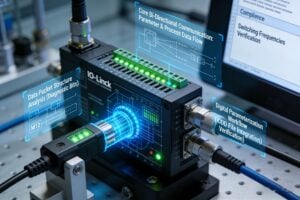
To objectively execute a flawless digital integration, control engineers must deeply analyze the precise bi-directional physics governing IO-Link master blocks and their subordinate devices. At the physical layer (PHY), IO-Link utilizes a 24V pulse modulation technique based on Universal Asynchronous Receiver-Transmitter (UART) protocol physics. The master block initiates all communication (Master-Slave architecture), interrogating the sensor via the standard C/Q switching line. The system operates across three distinct, standardized baud rates: COM1 (4.8 kbps), COM2 (38.4 kbps), and the highly advanced COM3 (230.4 kbps), which is strictly required for high-speed motion control and complex volumetric measurements.
[Image detailing an IO-Link data frame, visually breaking down the separation between cyclical process data, value status, and acyclic parameter data packets]
The data structure is mathematically partitioned into three distinct classifications. First, ‘Process Data’—the actual measured value, such as distance or pressure—is transmitted cyclically at intervals as fast as 400 microseconds. Simultaneously, ‘Value Status’ data is appended to the process frame, instantly validating the integrity of the measurement to the PLC. The most revolutionary aspect, however, is the acyclic ‘Device Data.’ This allows the central PLC to mathematically interrogate the sensor’s internal silicon, pulling hardware serial numbers, firmware versions, and precise internal temperature telemetry without disrupting the primary high-speed cyclical process loop.
Furthermore, this bi-directional channel unlocks dynamic digital parameterization. In legacy systems, modifying a photoelectric sensor’s background suppression range required a technician to physically walk onto the factory floor, halt the machine, and manually rotate a potentiometer with a screwdriver. With IO-Link, the PLC mathematically pushes a new parameter dataset down to the sensor in milliseconds. If an automated assembly line transitions from processing matte black components to highly reflective metallic components, the PLC instantly re-tunes the entire optical sensor array on the fly, guaranteeing zero continuous-process interruption.
Real-World Use Cases for Predictive Maintenance
The strategic deployment of digital edge transparency is aggressively dictated by the absolute severity of the deployment zone. Consider the massive, automated mineral extraction and heavy metallurgical processing hubs situated in Guizhou, China. These extreme industrial corridors operate massive rock crushers and high-temperature smelting furnaces in environments heavily saturated with highly conductive coal dust and extreme thermal gradients. Consequently, standard optical and capacitive sensors degrade violently; lenses become coated in particulates, slowly eroding the signal integrity until catastrophic machine blindness occurs.
Furthermore, facility engineers managing these critical Guizhou hubs cannot rely on reactive failure. Consequently, they strictly mandate the deployment of industrial data communication protocols driven by IO-Link. Therefore, as a photoelectric sensor lens slowly accumulates metallurgical dust, the internal microprocessor calculates the degrading photon return-rate. Furthermore, long before the signal drops below the critical switching threshold, the sensor autonomously transmits an acyclic ‘Maintenance Required’ event flag directly to the master block.
Consequently, this digital flag is instantly routed to the facility’s SCADA and predictive maintenance AI infrastructure. Therefore, the maintenance team is dispatched to wipe the specific sensor lens during a scheduled shift change, completely averting an unplanned line stoppage. Furthermore, if a sensor is physically crushed by a stray piece of ore, the Auto-Parameterization feature of the master block mathematically guarantees instant recovery. Consequently, when a technician plugs a factory-blank replacement sensor into the exact same port, the master block immediately verifies the Vendor ID and Device ID, and automatically flashes the exact required parameter dataset into the new hardware. Therefore, this proprietary architecture mathematically eliminates the need for manual configuration, securing continuous, high-margin manufacturing throughput.
Comparison Matrix: Industrial Sensing Interfaces
To objectively evaluate the structural and financial viability of varying sensing architectures during a facility upgrade, procurement engineers must critically analyze comparative integration data. The following matrix mathematically contrasts core sensing topologies based on diagnostic depth, wiring complexity, and signal resilience:
| Sensing Architecture | Diagnostic Depth & Telemetry | Wiring Complexity & Cost | Signal Integrity & EMI Resistance | Optimal Industrial Application |
| Standard SIO (Digital PNP/NPN) | Zero. Strictly a blind ON/OFF binary state. No internal health monitoring. | Low. Uses standard 3-wire unshielded M12/M8 cables. | Moderate. A 24V signal is relatively robust but offers no error-checking validation. | Basic limits, simple pneumatic cylinder tracking, and non-critical presence detection. |
| Analog Interface (4-20mA / 0-10V) | Minimal. Can detect a completely severed wire (0mA), but provides no internal component data. | High. Strictly requires expensive, heavily shielded twisted-pair cables to prevent noise. | Vulnerable. Analog voltage/current is highly susceptible to EMI from VFDs and motors. | Legacy temperature and pressure monitoring where digital upgrades are structurally impossible. |
| IO-Link (IEC 61131-9) | Supreme. Full internal temperature, signal degradation warnings, and device serial numbers. | Low. Reuses standard, cheap, unshielded 3-wire M12 cables. | Absolute. 24V digital packet transmission utilizes checksums to mathematically reject EMI noise. | Smart factories, predictive maintenance cells, and highly flexible multi-batch robotic lines. |
Execution Best Practices & Specs
Executing a structurally flawless digital sensor integration requires absolute adherence to rigorous software configuration protocols. The fundamental cornerstone of this architecture is the IO Device Description (IODD) file. Every IO-Link sensor possesses a highly specific XML-based IODD file provided by the manufacturer. This file contains the complete mathematical map of the device’s process data structure, diagnostic capabilities, and parameter ranges. If an engineer fails to import and parse the correct IODD file into the central PLC’s engineering software (e.g., TIA Portal or Studio 5000), the master block will fundamentally fail to translate the sensor’s raw hexadecimal payload into readable engineering units. Securing accurate IODD files alongside verified automation components is a strict engineering prerequisite.
[Image detailing the structural hierarchy of an IODD XML file, mapping raw hex data to human-readable pressure and temperature parameters]
Furthermore, structural parameters dictate that engineers must meticulously specify the correct Master Block port configurations. IO-Link masters feature two distinct port classifications: Port Class A and Port Class B. Port Class A utilizes pins 1, 3, and 4 for standard communication and device power, leaving pins 2 and 5 open for auxiliary digital inputs. Conversely, Port Class B fundamentally isolates pins 2 and 5 to provide a dedicated, galvanically isolated auxiliary power supply. This is strictly required when connecting high-current IO-Link actuators, such as smart pneumatic valve manifolds or electric grippers. Attempting to draw heavy actuator current through a standard Class A port will instantly collapse the master block’s internal power bus.
Finally, operators must enforce strict data validation utilizing the ‘Data Storage’ (Auto-Parameterization) parameter. The master block acts as a localized parameter server. Engineers must actively enable this feature during commissioning. If disabled, a replaced sensor will remain blank, defeating the primary downtime-mitigation advantage of the technology. By strictly adhering to these software and physical integration protocols, backed by a highly verified Enicstra supply chain, technicians guarantee their upgraded digital nodes maintain absolute clinical accuracy.
Frequently Asked Questions (FAQ)
- Why is the physical cable length for IO-Link strictly limited to 20 meters?
The 20-meter limitation is dictated by the physical capacitance of standard unshielded sensor cables. Because IO-Link utilizes high-speed 24V pulse modulation (up to 230.4 kbps), excessive cable lengths act as massive capacitors. This capacitance mathematically distorts the sharp rising and falling edges of the digital square wave. Beyond 20 meters, the signal degrades into an unreadable curve, causing the master block to reject the corrupted data packets.
- Can an IO-Link sensor operate on a legacy machine that does not possess an IO-Link Master?
Yes. IO-Link sensors are engineered with absolute backward compatibility. When powered up, the sensor defaults to Standard IO (SIO) mode. If it does not receive a dedicated digital ‘wake-up’ pulse from a master block, it simply functions as a standard PNP or NPN ON/OFF switch, allowing you to upgrade your hardware inventory before upgrading your control infrastructure.
- Does exposing sensor data digitally introduce severe cybersecurity vulnerabilities to the factory floor?
No. IO-Link is strictly a point-to-point physical connection, not a routable network protocol like TCP/IP. An external threat actor cannot ‘hack’ an individual sensor from the internet because it lacks an IP address. The cybersecurity perimeter must be established at the PLC and the Industrial Ethernet level (where the master block resides), mathematically insulating the edge devices from direct digital penetration.
- How does IO-Link Safety integrate into critical emergency shutdown protocols?
Standard IO-Link was not designed for functional safety. However, the newly ratified IO-Link Safety extension utilizes a ‘Black Channel’ principle, superimposing highly encrypted, redundant safety data packets (OSSD equivalents) over the standard communication line. This allows for the integration of safety light curtains and emergency stops up to SIL 3 / PLe while utilizing the same unshielded 3-wire architecture.
- Is the cyclical update rate of IO-Link fast enough for highly dynamic motion control applications?
While COM3 baud rates permit cycle times as low as 400 microseconds, IO-Link is generally deployed for sensor telemetry and auxiliary actuation, not primary closed-loop servo synchronization. For ultra-precise, nanosecond-level motion control, engineers must rely on specialized industrial Ethernet backbones like EtherCAT or PROFINET IRT, utilizing IO-Link as the supplementary data layer.
- What happens if I plug a sensor from Manufacturer A into an IO-Link master block from Manufacturer B?
Because the protocol is an open, rigorously governed IEC standard (IEC 61131-9), interoperability is mathematically guaranteed. A sensor from any certified vendor will seamlessly execute the wake-up protocol and transmit data to a master block from any other certified vendor. The only requirement is that the central PLC possesses the correct XML-based IODD file to translate the specific sensor’s payload.
Conclusion
The engineering reality within the high-stakes manufacturing landscape is mathematically irrefutable: attempting to govern a highly complex, predictive-maintenance-driven facility utilizing blind, analog sensors guarantees catastrophic unmonitored failures, severe diagnostic delays, and profound operational paralysis. By migrating your edge architecture directly to advanced digital point-to-point protocols sourced through the flawless Enicstra supply network, you permanently mathematicalize your facility’s data transparency and operational resilience. We guarantee absolute resistance to blind signal degradation, eradicate the threat of unmonitored environmental fouling, and unlock rapid, data-driven uptime for your entire engineering staff.
Do not compromise your facility’s predictive capabilities by relying on archaic voltage drops and unverified analog hardware. Secure the digital integrity of your entire industrial network by upgrading your edge-level telemetry today. Access our massive inventory of verified predictive maintenance AI components to instantly acquire high-efficiency IO-Link masters, execute flawless smart sensor integrations, and fundamentally revolutionize your global automation trajectory. Secure your industrial data transparency today.