
Every unplanned production stoppage costs manufacturers an average of $260,000 per hour according to Siemens research, yet 68% of plant managers report receiving counterfeit or substandard replacement parts within the past two years. The difference between a reliable automation parts distributor and a risky supplier often determines whether your facility restarts in 24 hours or faces weeks of delays. Most purchasing teams focus exclusively on price and delivery speed, missing critical verification steps that distinguish authentic components from failures waiting to happen.
Table of Contents
- Quick Takeaways
- Verify Manufacturer Authorization Status
- Demand Complete Traceability Documentation
- Inspect Quality Verification Processes
- Evaluate Obsolete Parts Sourcing Network
- Assess Technical Support Capabilities
- Examine Warranty and Return Policies
- Test Emergency Procurement Response
- Analyze Inventory Management Systems
- Review Shipping and Customs Expertise
- Validate Payment Security Protocols
- Check Industry Certifications
- Compare Pricing Transparency
- Frequently Asked Questions
- References
Quick Takeaways
| Key Insight | Explanation |
|---|---|
| Authorization verification prevents 90% of counterfeit risks | Authorized distributors maintain direct manufacturer relationships with documented supply chains, while gray market sellers cannot provide verifiable authorization letters |
| Traceability documentation should include minimum 4 data points | Legitimate parts include manufacturer certificates, batch numbers, date codes, and country of origin documentation that gray market suppliers typically cannot furnish |
| Quality testing procedures separate professionals from brokers | Distributors with in-house testing facilities using calibrated equipment catch defects before shipment, while brokers ship directly from unknown sources |
| Emergency response time reveals supply chain depth | Distributors with extensive networks locate critical parts in 4-8 hours, while limited suppliers require 48-72 hours just to confirm availability |
| Warranty coverage indicates component confidence | Distributors offering 12-24 month warranties stand behind authenticity, while short or no warranty periods signal uncertainty about component provenance |
| Technical support capability correlates with part authenticity | Distributors with engineering teams provide compatibility verification and installation guidance, distinguishing them from transaction-only suppliers |
| Customs expertise reduces international delays by 40% | Experienced global distributors navigate HS codes, duty classifications, and import regulations that frequently trap inexperienced suppliers |
Verify Manufacturer Authorization Status
Request written authorization letters directly from the OEM, not from the distributor’s website. In practice, authorized distributors maintain current documentation they can email within hours, while unauthorized sellers deflect with vague claims about “factory relationships” or “authorized sources.”
The authorization verification process should include the distributor’s legal business name, not just a trade name or DBA. Counterfeit operations frequently use similar names to legitimate distributors, differing by one letter or punctuation mark. Cross-reference the business registration with the manufacturer’s official distributor list published on their corporate website.
Pro tip: Call the OEM’s sales department directly and ask if the distributor holds current authorized status for the specific product lines you need. Manufacturers maintain these records and will confirm or deny authorization in minutes.
Authorization status changes frequently as manufacturers revoke relationships for quality violations or contract breaches. A distributor authorized two years ago may have lost that status, making historical screenshots or outdated certificates meaningless. Always verify current authorization dated within the past 90 days.
Demand Complete Traceability Documentation
Every authentic industrial component leaves a paper trail from factory to customer. Legitimate automation parts distributors provide manufacturer certificates of conformity, batch traceability numbers, and shipping documentation that links components directly to production facilities.
The absence of any single traceability element indicates problems. Gray market parts lack manufacturer certificates because they entered distribution channels through unauthorized routes. Refurbished components missing date codes suggest previous use that sellers intentionally obscure. Components with mismatched serial numbers and packaging originated from multiple sources and were repackaged to appear uniform.
Critical Documentation Requirements
Certificate of Conformity documents must include the manufacturer’s official letterhead, authorized signature, and component-specific serial numbers or batch codes. Generic certificates covering multiple part numbers or lacking specific identifiers serve no verification purpose.
Material Safety Data Sheets prove the distributor maintains direct manufacturer communication channels. MSDS documents contain technical specifications that only OEMs provide, and their presence indicates the distributor receives official documentation packages rather than acquiring parts through secondary markets.
Country of origin documentation becomes essential for compliance with trade regulations and tariff classifications. Distributors that cannot specify manufacturing location either lack supply chain visibility or deliberately obscure questionable sourcing practices.
Inspect Quality Verification Processes
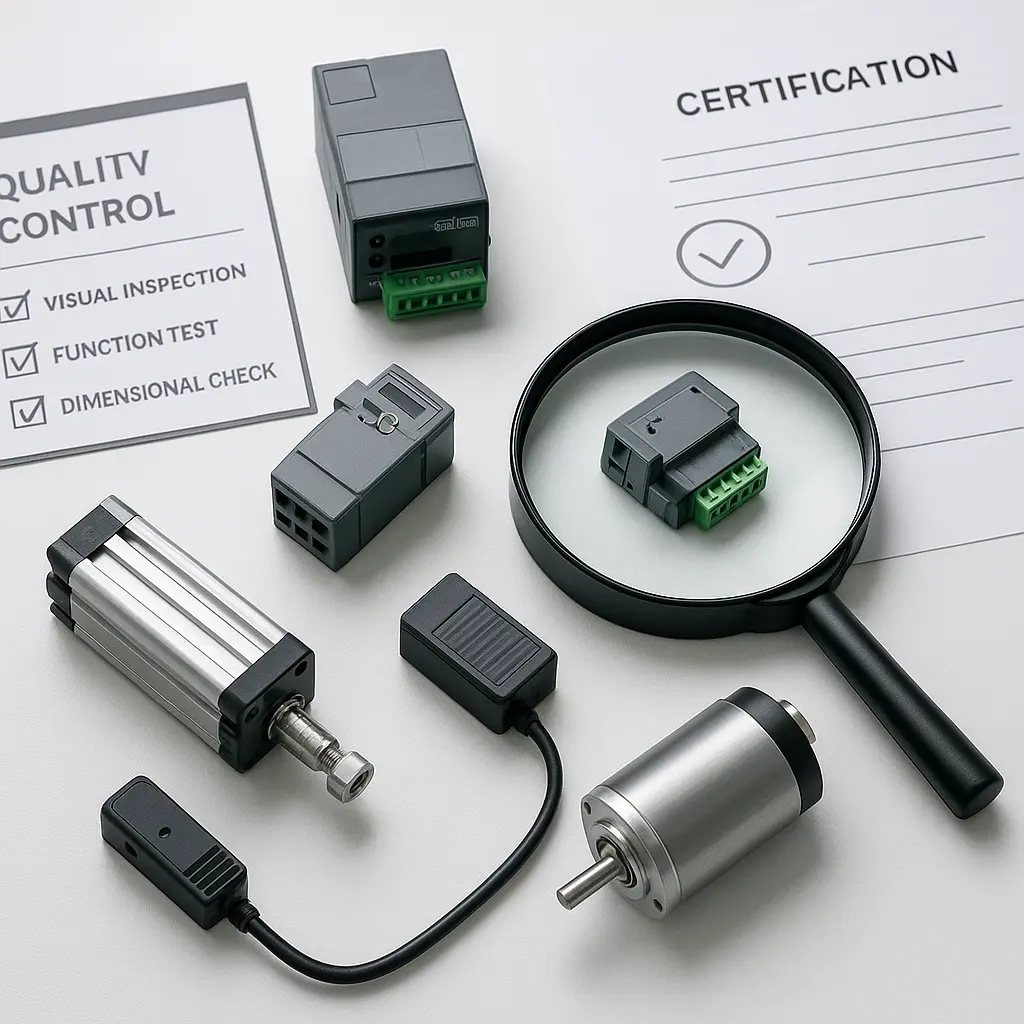
The data consistently shows that quality verification procedures differentiate professional distributors from part brokers masquerading as authorized suppliers. Testing protocols should include incoming inspection, functional testing where applicable, and documentation review before components reach warehouse inventory.
Ask specifically about testing equipment and calibration schedules. Distributors with ISO 9001 certification maintain calibrated instruments traceable to national standards, while brokers cannot demonstrate equipment calibration or testing procedures. The absence of documented testing protocols indicates parts ship directly from suppliers without verification.
According to the International Society of Automation, counterfeit components fail at rates 10 to 15 times higher than authentic parts, making incoming quality verification the single most important risk mitigation step in the supply chain.
Visual inspection procedures should specifically target common counterfeit indicators including inconsistent labeling, packaging quality variations, and physical appearance discrepancies compared to known authentic samples. Distributors maintaining reference samples from verified purchases can immediately spot suspicious components.
Pro tip: Request photos of the distributor’s testing facility and quality control area during your evaluation. Legitimate operations willingly share facility images, while questionable suppliers claim proprietary concerns or provide generic stock photos.
Evaluate Obsolete Parts Sourcing Network
The ability to locate discontinued and obsolete automation components separates established distributors from commodity resellers. Manufacturing facilities operating equipment installed 10-20 years ago require replacement parts that OEMs stopped producing, creating a specialized sourcing challenge.
Ask how the distributor locates obsolete components. Professional networks include relationships with factories holding residual inventory, authorized repair facilities with surplus stock, and equipment manufacturers undergoing product transitions. Vague answers about “global networks” or “supplier relationships” indicate limited actual capabilities.
Response time for obsolete part quotes reveals network depth. Distributors with extensive sourcing capabilities provide availability confirmation and pricing within 4-8 business hours for most components. Suppliers requiring 5-10 days for quote responses lack established networks and spend that time cold-calling potential sources.
Minimum order quantities for obsolete parts indicate whether the distributor stocks components or brokers transactions. Distributors willing to sell single units from existing inventory demonstrate commitment to solving customer problems rather than maximizing transaction values through forced bulk purchases.
Assess Technical Support Capabilities
Technical support separates genuine industrial component specialists from transactional resellers. Manufacturing facilities need distributors who understand application requirements, verify compatibility, and provide installation guidance beyond simply processing orders.
Test technical knowledge by asking specific compatibility questions about your equipment and automation systems. Knowledgeable distributors immediately identify potential conflicts, recommend alternatives when specified parts don’t fit applications, and explain technical differences between component variants. Order processors deflect technical questions to manufacturers or claim all variants are interchangeable.
Engineering Support Indicators
In-house engineering staff indicates serious technical capability investment. Distributors employing engineers with industrial automation backgrounds provide application review, system integration advice, and troubleshooting support that purchasing agents and sales representatives cannot deliver.
Multilingual technical support becomes critical for global manufacturing operations. Facilities coordinating between headquarters in one country and plants in multiple regions need distributors whose engineering teams communicate effectively across languages and time zones, reducing miscommunication that causes wrong part orders.
Documentation quality reflects technical understanding. Distributors that provide detailed technical datasheets, compatibility matrices, and installation instructions demonstrate component knowledge, while suppliers offering only manufacturer part numbers lack the expertise to support complex industrial applications.

Examine Warranty and Return Policies
Warranty terms directly reflect distributor confidence in component authenticity and quality. Authorized distributors offering 12-24 month warranties back their claims about sourcing authentic parts from legitimate supply chains, while limited warranty periods signal uncertainty about component provenance.
Read warranty exclusions carefully. Policies excluding normal industrial use, environmental exposure, or electrical stress indicate distributors selling refurbished or previously used components marketed as new. Authentic new components include manufacturer warranties covering standard industrial operating conditions.
Return policies reveal whether distributors stand behind their quality claims. Professional suppliers accept returns for wrong parts, compatibility issues, or quality defects with minimal restocking fees and straightforward processes. Complex return requirements with high restocking charges and narrow return windows protect distributors from customer dissatisfaction rather than ensuring customer success.
Response time for warranty claims separates committed suppliers from those that disappear after payment. Test this before committing to large orders by asking about typical warranty claim processing times and requesting contact information for customers who recently filed claims.
Test Emergency Procurement Response
Production emergencies reveal distributor capabilities better than routine orders. When critical equipment fails at 2 AM on Sunday, response speed determines whether production restarts Monday morning or remains offline for days.
Test emergency response during the evaluation phase by requesting quotes for hard-to-find components with tight deadlines. Distributors with robust networks provide availability confirmation and expedited delivery options within hours, while limited suppliers require business days just to investigate possibilities.
After-hours accessibility indicates service commitment. Distributors offering 24/7 phone support or emergency contact numbers demonstrate understanding of manufacturing reality where equipment failures follow no schedule. Suppliers with voicemail-only after-hours service force customers to wait until business hours.
Emergency surcharge structures reveal pricing philosophy. Reasonable expedite fees covering actual costs like overnight shipping and staff overtime are acceptable, while excessive premiums exploiting customer desperation indicate predatory practices that become problematic during urgent situations.
| Distributor Type | Emergency Response Time | Key Characteristics |
|---|---|---|
| Global Network Specialist | 4-8 hours for availability confirmation | Extensive supplier relationships, multiple sourcing options, 24/7 support, expedited shipping expertise, typically higher prices offset by reliability |
| Regional Stockist | Next business day for common items | Strong inventory for popular components, limited obsolete parts capability, business hours support, competitive pricing on stocked items |
| Transaction Broker | 48-72 hours minimum response | No inventory, sources parts after receiving orders, limited technical support, lowest initial quotes but frequent delays and substitutions |
Analyze Inventory Management Systems
Real-time inventory visibility prevents the common problem where distributors accept orders for out-of-stock components and notify customers of delays only after payment processing. Professional inventory systems display actual stock quantities and warehouse locations rather than vague “in stock” claims.
Request access to the distributor’s online inventory portal during evaluation. Systems showing specific quantities, warehouse locations, and estimated delivery dates from each facility demonstrate inventory control sophistication. Portals displaying only “available” or “contact for availability” hide inventory uncertainty behind sales intervention requirements.
Inventory accuracy directly impacts delivery reliability. A common mistake is accepting distributor claims about extensive inventory without verification. Request inventory reports for critical parts you regularly need, then place test orders to confirm actual stock matches reported quantities.
Forecasting support from distributors with sophisticated inventory systems helps prevent emergency situations. Distributors analyzing your historical purchasing patterns can recommend stocking strategies, identify long-lead-time components requiring advance orders, and alert you to component discontinuations before they cause production problems.
Review Shipping and Customs Expertise
International component procurement introduces customs complexity that inexperienced distributors consistently underestimate. Incorrect HS code classifications, incomplete commercial invoices, and missing required documentation cause shipment delays averaging 7-14 days according to logistics industry data.
Distributors with global shipping expertise handle documentation preparation, duty calculation, and customs clearance coordination without requiring customer intervention. They understand country-specific import requirements, restricted materials regulations, and hazmat shipping classifications that frequently trap inexperienced suppliers.
Customs Documentation Requirements
Commercial invoice accuracy prevents most customs delays. Experienced distributors provide complete invoices including harmonized tariff codes, country of origin, and detailed component descriptions that customs officials require for classification. Incomplete invoices trigger holds while customs agents request additional information.
Certificate of origin documentation becomes mandatory for preferential duty treatment under trade agreements. Distributors familiar with USMCA, EU trade agreements, and other preferential programs reduce your landed costs by securing lower duty rates through proper documentation.
Freight insurance and incoterms clarity protects against shipment loss or damage. Distributors should clearly specify responsibility transfer points and provide adequate insurance coverage, not assume customers understand international commercial terms without explanation.
Pro tip: Request examples of commercial invoices and shipping documentation the distributor prepares for international shipments. Professional formatting and complete information indicate customs expertise, while sparse details signal potential delay risks.
Validate Payment Security Protocols
Payment security protects against both fraud and business continuity risks. Supplier evaluation must include verification that distributors maintain secure payment processing and financial stability to fulfill orders without sudden business closures.
Accepted payment methods reveal business legitimacy. Established distributors accept purchase orders from qualified businesses, major credit cards, wire transfers, and letters of credit. Suppliers demanding only cryptocurrency, Western Union, or prepaid cards exhibit red flags associated with fraudulent operations.
PCI DSS compliance for credit card processing indicates investment in security infrastructure. Distributors processing cards through compliant systems protect your financial information, while those using personal accounts or non-secure methods risk data breaches and financial exposure.
Net payment terms availability signals distributor confidence in customer relationships and financial stability. Established businesses extend 30-60 day terms to qualified customers, while operations requiring full prepayment on all orders either lack working capital or maintain high customer dispute rates.
Check Industry Certifications
Industry certifications provide independent verification of quality management, environmental compliance, and business practices. ISO 9001 certification demonstrates documented quality management systems, while its absence indicates informal procedures vulnerable to inconsistency and errors.
AS9120 certification specifically addresses aerospace and defense distribution requirements. Distributors serving multiple industries with AS9120 certification demonstrate quality system sophistication exceeding typical commercial distribution standards, beneficial even for non-aerospace applications.
ISO 14001 environmental certification indicates commitment to sustainable business practices and regulatory compliance. Manufacturing facilities increasingly require suppliers to demonstrate environmental responsibility as part of corporate sustainability initiatives.
The Independent Distributors of Electronics Association reports that certified distributors experience 73% fewer quality incidents and 58% fewer customer disputes compared to non-certified competitors, making certification status a reliable proxy for operational excellence.
Certification currency matters as much as certification existence. Request copies of current certificates including audit dates and expiration dates. Expired certifications indicate declining quality commitment, while distributors prominently displaying outdated certificates deliberately mislead customers about their current status.

Compare Pricing Transparency
Pricing transparency separates straightforward suppliers from those using opacity to maximize margins through information asymmetry. Detailed quotes listing component costs, shipping fees, applicable duties, and service charges allow accurate cost comparison, while lump-sum pricing hides margin distribution and prevents verification.
Published pricing for common components demonstrates confidence in competitiveness. Distributors requiring quote requests for every part number create unnecessary friction and signal prices vary based on perceived customer desperation rather than consistent margin structures.
Volume discount structures should follow logical progression. Distributors offering 5% discount at 10 units, 10% at 50 units, and 15% at 100 units demonstrate rational pricing, while erratic discount jumps or unclear qualification thresholds suggest arbitrary pricing decisions.
Price matching policies indicate market awareness. Distributors willing to match documented competitor quotes for identical components demonstrate competitive confidence, while those refusing price matching either maintain premium pricing without justification or lack flexibility to compete on commercial terms.
Hidden fees destroy pricing transparency. Watch for surprise charges added during checkout including documentation fees, inspection charges, handling fees, or packaging costs. Legitimate cost components should appear in initial quotes, not emerge during payment processing.
Frequently Asked Questions
How can I verify a distributor actually has parts in stock before placing an order?
Request specific inventory confirmation including warehouse location and bin numbers for critical orders. Professional distributors provide this information within hours and can send photos of components if requested. Place small test orders before committing to large purchases to verify delivery times match promises. Distributors with real inventory ship test orders within quoted timeframes, while those lacking stock make excuses about unexpected delays or suggest substitutions.
What warranty length should I expect from a reputable automation parts distributor?
Reputable distributors selling authentic new components provide minimum 12 month warranties, with many offering 18-24 months for industrial automation parts. Warranties should cover defects, authenticity issues, and compatibility problems without excessive exclusions. Distributors offering only 30-90 day warranties either sell refurbished components, lack confidence in their supply chain, or source from gray market channels where component history remains uncertain.
How quickly should a distributor respond to urgent component requests?
Distributors with robust networks provide availability confirmation within 4-8 hours for most components, even outside normal business hours. Emergency response capability requires 24/7 contact access and staff empowered to commit inventory and arrange expedited shipping without waiting for management approval. Suppliers requiring 24-48 hours just to check availability lack the network depth and urgency commitment necessary for manufacturing support.
What documentation proves components are authentic rather than counterfeit?
Authentic components include manufacturer certificates of conformity with component-specific serial numbers, traceability documentation showing factory origin, and packaging matching current OEM standards. Request photos before shipment showing packaging, labels, and date codes. Verify certificate authenticity by contacting the manufacturer directly using contact information from their official website, not information provided by the distributor. Distributors refusing documentation requests or providing only generic paperwork cannot verify authenticity.
Should I pay premium prices to authorized distributors versus buying from lower-cost suppliers?
The premium for authorized distributors typically ranges 10-25% above gray market prices but prevents the catastrophic costs of counterfeit parts causing equipment damage, production delays, and safety incidents. Manufacturing downtime costing hundreds of thousands per hour makes the authorization premium irrelevant compared to failure risks. Lower-cost suppliers selling authentic parts exist, but verification requires extensive due diligence including the quality checks outlined in this guide. For critical components where failure causes production stoppage, authorized distributor premiums represent insurance against far larger potential losses.
How can I evaluate a distributor’s technical expertise before placing orders?
Ask specific technical questions about component compatibility with your equipment during initial conversations. Knowledgeable distributors immediately understand application requirements, identify potential issues, and recommend appropriate alternatives when needed. Request to speak with engineering staff rather than only sales representatives. Review technical documentation quality including datasheets, installation guides, and compatibility information. Distributors with genuine expertise provide detailed technical support, while transactional suppliers deflect technical questions or provide only basic manufacturer information without application guidance.
What quality verification procedures have proven most effective in your experience evaluating automation parts distributors, and which warning signs indicated problems before they caused production issues?
References
- National Institute of Standards and Technology manufacturing quality standards and calibration traceability guidelines
- Statista industrial manufacturing statistics and production downtime cost analysis
- International Society of Automation technical standards and counterfeit component research
- International Trade Administration customs regulations and import documentation requirements
